

Power and data transmission
The reliable transmission of data and power forms a central foundation of modern electrical and electronic systems. In virtually all areas of application – from industrial automation over information and communication technology to automotive and medical technology – high-performance, low-interference transmission links are of crucial importance. Both wired and wireless technologies are used, each presenting specific advantages, challenges and requirements.
The following diagram provides an illustrative overview of the various transmission networks in an industrial environment:
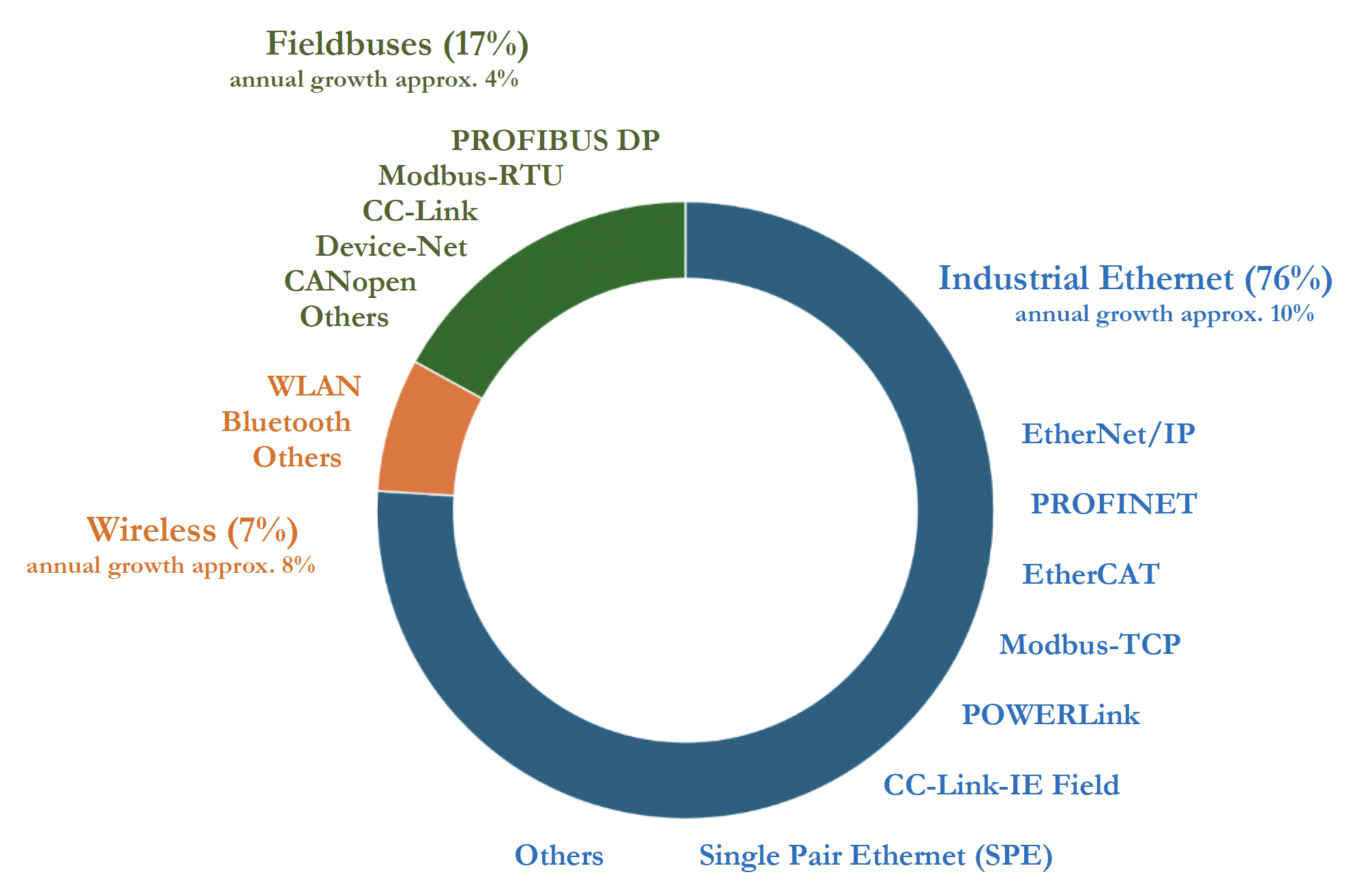
- Figure 1 – Overview of industrial networks, as of 2025

Wired transmission methods such as traditional copper cables, coaxial cables and fibre-optic cables have been used successfully for decades. Single Pair Ethernet (SPE) in particular has recently been gaining in importance, especially in industrial automation and in building and vehicle technology. SPE enables data transmission over just a single twisted pair and, in combination with Power over Data Line (PoDL), allows the simultaneous transmission of data and electrical power. In other application areas, standards and protocols such as Ethernet, CAN, USB, HDMI or Powerline (PLC) are widely used and enable high data rates, robust communication and flexible system architectures.
At the same time, wireless technologies are becoming increasingly important. Radio-based systems such as Wi-Fi, Bluetooth, NFC and mobile communications standards, as well as contactless power transfer methods based on inductive or resonant principles, enable new applications and a high degree of flexibility. At the same time, these technologies place increased demands on electromagnetic compatibility, as they are particularly sensitive to interference and can themselves act as sources of interference.
However, as transmission frequencies, data rates and power densities increase, so too do electromagnetic interference, line attenuation, crosstalk and radiation.
Interference suppression through the use of ferrites
Against this backdrop, the suppression of interference and the shielding of data and power transmission lines play a central role. Ferrite components have established themselves as tried-and-tested passive components for attenuating high-frequency interference, suppressing common-mode interference and reducing electromagnetic emissions without significantly compromising the integrity of the useful signals. In doing so, they make an important contribution to compliance with electromagnetic compatibility requirements and, in particular, facilitate the achievement of regulatory limits for conducted and radiated emissions. At the same time, they contribute to greater functional reliability of electronic systems by reducing interference-induced impairments to signal transmission and increasing robustness against external electromagnetic influences. These positive effects are significant in numerous technical fields of application, particularly in medical technology, industrial automation and in telecommunications and communications technology, where both high operational reliability and compliance with strict EMC requirements are essential. Furthermore, specially shaped ferrite components can often be integrated into existing systems in such a way that the geometry and mechanical design of the overall system are altered only slightly, which further facilitates their practical implementation.
In the context of data and power transmission, ferrites and related EMC measures can broadly be divided into two main applications: the suppression of high-frequency signals in wired transmission paths, and the shielding of wireless transmission links against unwanted electromagnetic coupling. Both functions are based on different physical principles and objectives.
Suppression of RF signals in wired systemsen
In wired transmission lines, high-frequency interference components frequently occur alongside the desired useful signals. These arise, for example, from steep switching edges in power electronics, from switched-mode DC/DC converters, or from electromagnetic coupling from adjacent lines. Ferrite components are used here specifically as frequency-dependent impedances.
Interference suppression ferrites act like a choke with low inductance. At high frequencies, the component behaves like an inductor with high losses and high reactive resistance. They have a low quality factor. The losses required in this application prevent resonance with parasitic and line capacitances. Conversely, inductors with a high quality factor are not well suited as interference filters.
A ferrite can be described electrically as a complex impedance:
Z(f) = R(f) + jX(f)
Where:
Z(f): the complex impedance
R(f): the real part (loss component/resistive)
X(f): the imaginary part (reactive component/inductive)
Both components, R(f) and X(f), are highly frequency-dependent.
The imaginary part X(f)
At low frequencies, the ferrite behaves mainly like an inductor:
XL = 2 π f L
An electric current generates a magnetic field in the ferrite’s inductance. In this process, energy is cyclically stored in the magnetic field and released again; it is not dissipated. The useful signal is hardly attenuated. In unfavourable cases (e.g. in conjunction with capacitance), this can lead to resonance and thus to an increase in the interference signal.
The real part R(f)
As frequency increases, magnetic losses such as hysteresis losses and eddy current losses occur. These lead to an increasing real part of the impedance. In the real part of the impedance, RF interference energy is converted into heat and removed from the signal path. This allows resonance effects to be suppressed.
The frequency-dependent interaction
At low frequencies, the ferrite is predominantly inductive. This results in low attenuation of the interference signal. At medium frequencies, the resistive component of the impedance increases sharply. This is where the maximum attenuation of the RF interference signal occurs. Energy is absorbed and converted into heat. At very high frequencies, parasitic capacitances come into play. The magnetic effect of the ferrite decreases. The impedance drops.
Ferrites provide better interference suppression than ideal coils, as they have a high loss component. The RF energy is not reflected but dissipated. This prevents resonances and is extremely important in terms of EMC.
The following diagram illustrates the frequency responses of Z, R and X for the Neosid ferrite material F02:
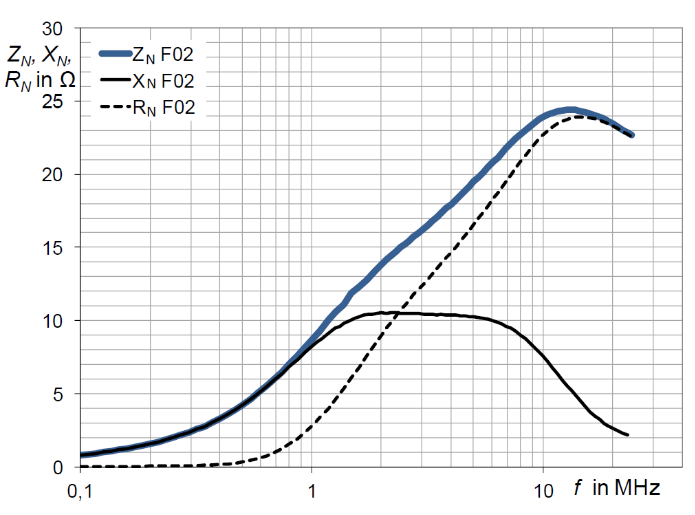
- Figure 2 – Impedance as a function of frequency for ferrite material F02 (MnZn)

Complex permeability
The reason for the effective interference suppression provided by ferrites lies in their complex permeability:
μ = μ‘ – jμ“
Where:
μ: the complex permeability
μ‘: the storage inductance component X
μ“: the loss component or real part R
As frequency increases, μ” grows and attenuation increases.
In practical terms, this can be summarised as follows: ferrite is not an ideal inductor, but a lossy HF resistor whose loss component increases with frequency.
The following graph shows, by way of example, the frequency-dependent characteristic curves for μ‘ and μ“ for the Neosid ferrite material F02:
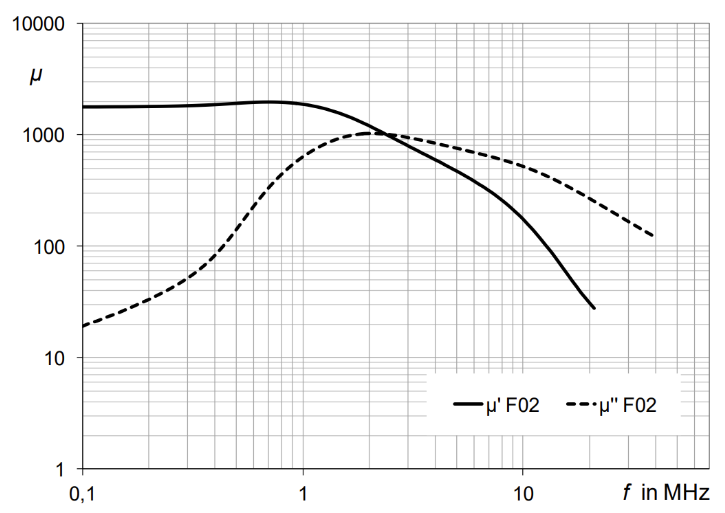
- Figure 3 – Complex permeability as a function of frequency for the ferrite material F02(MnZn)

Ferrites are particularly effective at suppressing common-mode interference, as this is often responsible for unwanted radiation. Ferrite cores or beads placed along cables increase the common-mode impedance without significantly affecting the differential signal path. At low frequencies or with DC voltage, they have virtually no effect.
Ferrite decoupling elements enable compliance with EMC limits and stabilise signal quality, particularly with high-speed protocols such as Ethernet or Single Pair Ethernet.
Shielding of wireless transmission links
In wireless transmission methods, signals are transmitted via electromagnetic fields. The challenge here lies not so much in reducing conducted interference, but rather in controlling and limiting the field distribution. Ferritic materials are used for magnetic shielding in this application. Due to their high magnetic permeability, they specifically influence the magnetic field distribution by focusing, deflecting or attenuating field lines
This is equally important in inductive or resonant energy transfer systems, which utilise alternating magnetic fields. Here, ferrites reduce stray fields, minimise losses and reduce unwanted coupling to neighbouring electronic assemblies. At the same time, they help to limit electromagnetic emissions and increase immunity to external fields..
One example of this is the inductive transmission path used in contactless charging for various vehicles. Passenger cars, e-bikes or other mobile vehicles can be conveniently and efficiently supplied with energy using this technology.
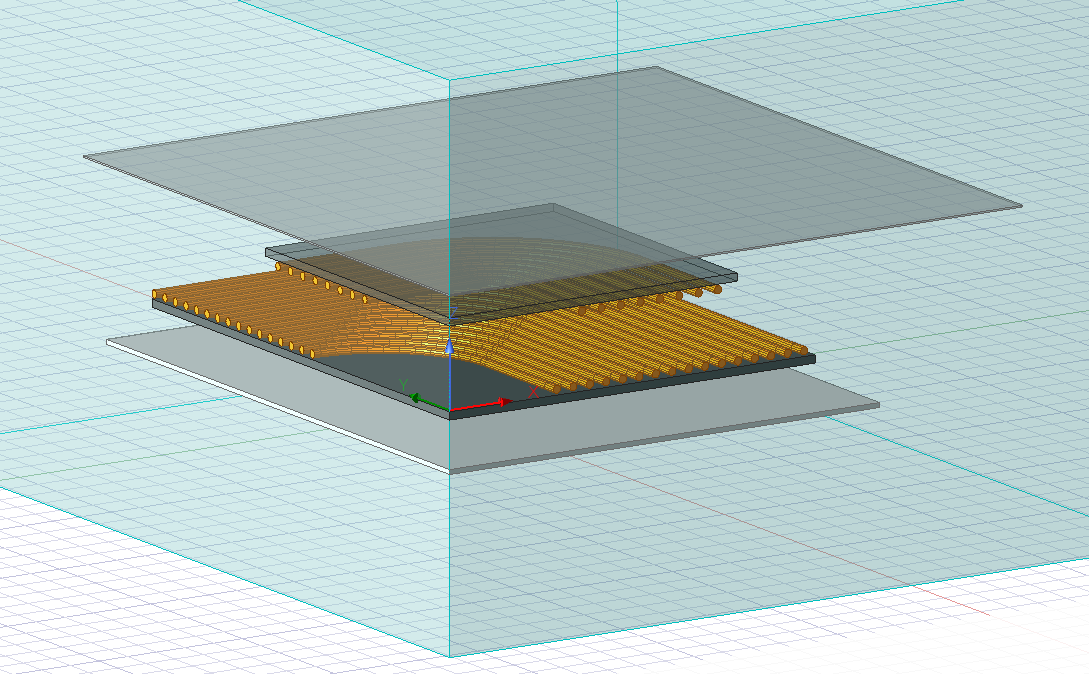
- Figure 4 – Simulation of a transmission coil for the inductive charging of an electric vehicle (EV)

In summary, ferrites serve both to provide frequency-selective attenuation of unwanted RF interference in wired systems and to specifically influence electromagnetic fields in wireless transmission links. They therefore represent a central element of modern EMC-compliant system designs.
Neosid – Your specialist for custom-fit ferrites
As a manufacturer of soft magnetic ferrites, Neosid is able to tailor ferrite components specifically to the electromagnetic and mechanical requirements of modern data and power transmission systems. The design is always application-oriented and takes into account both the physical mechanisms of interference suppression and the geometric constraints of the respective application.
The starting point for electromagnetic design is the analysis of the relevant frequency spectrum. Depending on whether the ferrites are used to suppress conducted high-frequency interference or to influence magnetic fields in wireless transmission links, material systems with defined complex permeabilities (μ’ and μ’’) are selected from a wide range of different materials. For RF interference suppression, the focus is on a high loss factor in the target frequency range in order to effectively attenuate interference currents and convert them into heat. For shielding and field-guiding applications, on the other hand, high permeabilities and low losses are paramount in order to direct magnetic field lines in a targeted manner and reduce stray fields.
The geometric design of the ferrite components takes place in parallel with the material selection. The shape, wall thickness and effective cross-section are dimensioned in such a way that the desired impedance or magnetic effect is achieved without generating undesirable saturation effects or resonances. In wired applications, for example, closed or split cores, sleeves or multi-hole geometries are used to achieve maximum common-mode impedance with minimal impact on the useful signal. For wireless power transfer systems, flat or segmented ferrite structures are being developed that can be optimally integrated into the installation space and support a homogeneous field distribution.
To validate the design, Neosid uses numerical simulation methods, such as electromagnetic field simulations and equivalent circuit models, supplemented by material- and component-specific measurements. Prototypes are characterised under real operating conditions to validate attenuation, losses and thermal behaviour. Through this close integration of material development, geometric design and metrological verification, Neosid is able to provide customised ferrite solutions that reliably meet both EMC requirements and mechanical and thermal constraints.
Always perfectly tailored
Thanks to our specialised injection moulding process, we can produce ferrite shapes optimised specifically for your application, the task you have defined and the installation space you have specified – shapes that would not be possible using the conventional dry-pressing method. We offer a wide range of ferrites made from nickel-zinc (Ni-Zn), manganese-zinc (Mn-Zn) and composite materials (e.g. metal powder and polymer).
Have we sparked your interest?
Get in touch – we develop custom-fit components from the latest generation of soft magnetic ferrites.